PPC management pricing is quoted in at least four different ways, which is why two agencies can look at the same account and come back with $900 and $9,000. Most pricing guides in this category answer the agency-side question of how much to charge. This one answers the buyer's question: how much does PPC cost, what the agency fee should include, and how to tell whether yours is fair.
The short answer: what PPC management costs in 2026
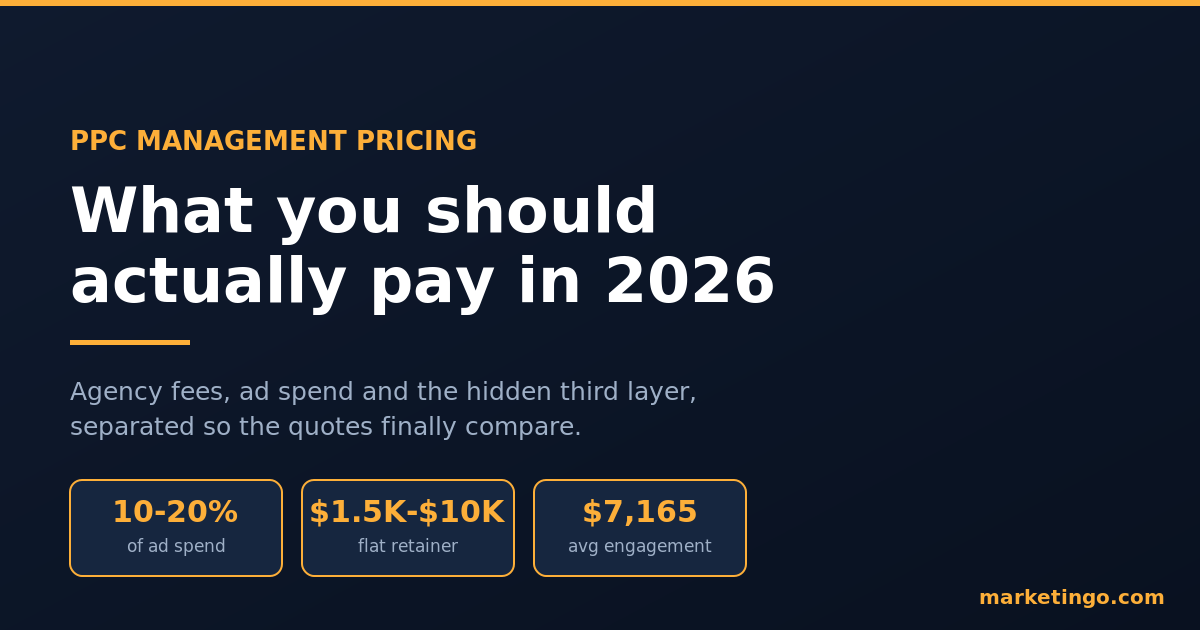
For most US businesses, a competent agency retainer lands between $1,500 and $10,000 a month, on top of the media budget. Clutch, which collects verified client reviews, puts the average PPC management cost per engagement at $7,165 a month. Percentage-based fees usually sit between 10% and 20% of ad spend, sliding down as budgets rise.
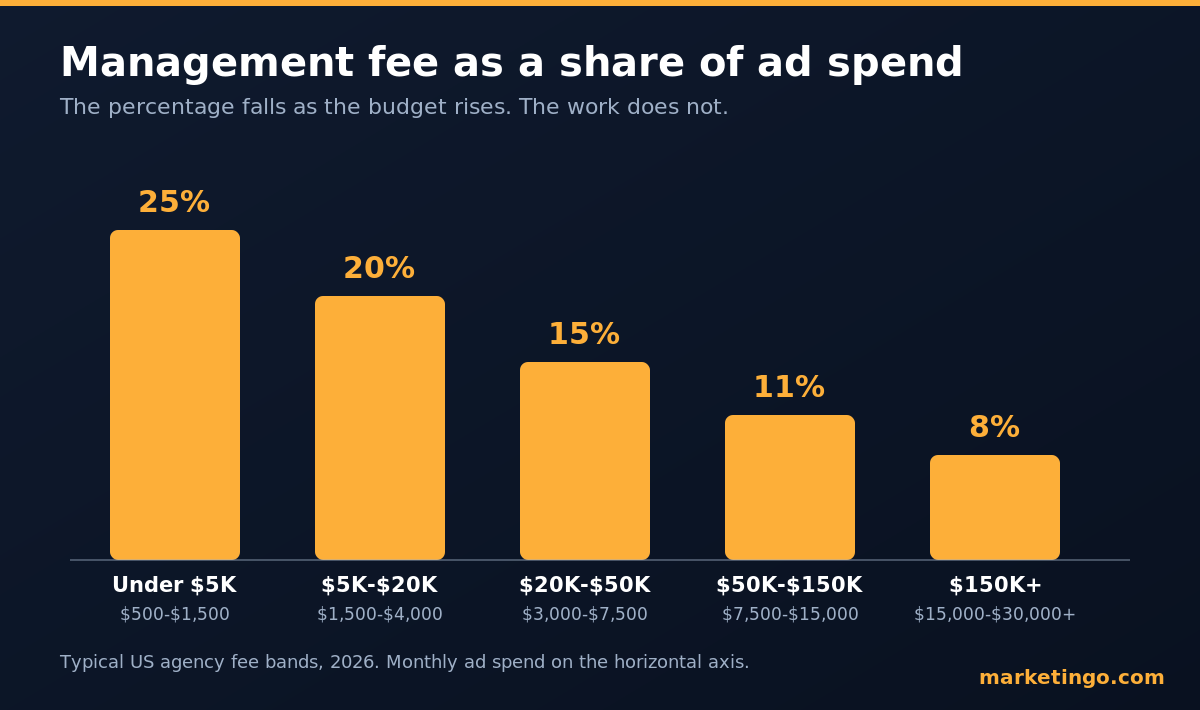
| Ad spend per month | Typical monthly fee | Usual model | What the fee normally covers |
|---|---|---|---|
| Under $5,000 | $500 to $1,500 | Flat retainer | One platform, light-touch optimization |
| $5,000 to $20,000 | $1,500 to $4,000 | Flat retainer or 12% to 20% | One or two platforms, active management |
| $20,000 to $50,000 | $3,000 to $7,500 | 12% to 15%, or hybrid | Multi-platform, creative and landing page input |
| $50,000 to $150,000 | $7,500 to $15,000 | Hybrid, capped percentage | Full-funnel, attribution, dedicated senior team |
| $150,000+ | $15,000 to $30,000+ | Custom or hybrid | Enterprise measurement, incrementality testing |
Those figures are agency fees only. The media budget sits on top, and the total cost of PPC is dominated by what you pay the platforms rather than by what you pay for management.
Two caveats before you use that table as a negotiating position. Fee level tracks the seniority of whoever touches the account, not the size of the agency logo. And a low fee against a large budget is often the worst deal on the page, for reasons the math further down makes obvious.
What you are actually paying for: three layers of cost
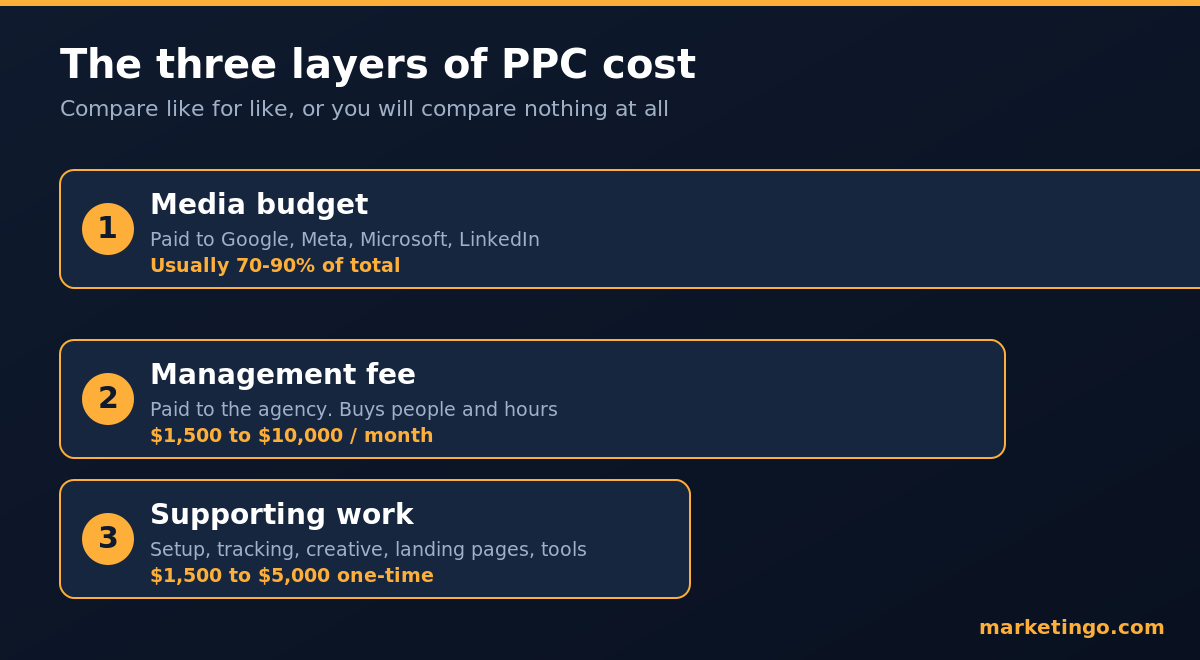
Understanding PPC pricing starts with separating three things that quotes routinely blend together. Buyers get burned when they compare one agency's fee against another agency's fee plus ad budget, so split the layers before you compare anything.
Layer 1: the media budget
This is money that goes to Google, Meta, Microsoft, or LinkedIn, never to the agency. It is also the biggest number, and the one benchmarks describe. WordStream's 2026 Google Ads benchmarks, drawn from more than 13,000 US search campaigns running between April 2025 and March 2026, put the average cost per click at $5.42, the average click-through rate at 6.64%, the average conversion rate at 8.18%, and the average cost per lead at $66.69.
Those averages hide enormous spread. Attorneys and legal services average $9.87 per click, home improvement $8.33, and dentists $8.00, while arts and entertainment sits at $1.63 and restaurants at $2.05. Paid social behaves differently again: Meta CPMs in the US run around $23 against a global average nearer $14, and LinkedIn typically costs $5.50 to $8.00 per click with a cost per lead in the $75 to $150 band for B2B campaigns. If you sell into an $8 per click category, a $2,000 media budget buys 250 clicks, which is not enough traffic for anyone to optimize against.
| Channel | Typical cost signal | What it means for budget |
|---|---|---|
| Google Search | $5.42 average CPC, $66.69 average cost per lead | Highest intent, highest price per click |
| Google Shopping and PMax | Cheaper clicks, ROAS driven by feed quality | Budget follows catalog margin |
| Meta | US CPM around $23 | Cheap reach, creative decides the outcome |
| Microsoft Ads | Prices commonly below Google for the same terms | Useful second search channel, smaller volume |
| $5.50 to $8.00 CPC, $75 to $150 cost per lead | Precision targeting at a premium |
Those four PPC platforms behave differently enough that one blended fee rarely fits all of them. Retail media prices differently again: Amazon PPC is normally quoted as a percentage of Amazon ads spend, and it sits outside the Google, Meta, LinkedIn, and Microsoft scope covered here.
Layer 2: the management fee
This is the agency's money, and it pays for people. Independent hourly rates give you a sanity check: Clutch reports professional PPC work commonly billed at $100 to $149 per hour, and the wider market runs roughly $50 to $100 for junior execution, $100 to $175 for a mid-level specialist, and $175 to $300 for a senior strategist. Divide any quoted retainer by a realistic blended rate and you get the honest answer to how many hours your account will see.
Layer 3: the supporting work
Onboarding, tracking setup, feed work, creative production, and landing pages sit outside most retainers. Expect a one-time setup fee somewhere between $1,500 and $5,000 for a serious build, and ask directly whether landing page work is included or billed separately. Tooling adds up too: call tracking, feed management, and reporting platforms are routinely rebilled at cost. The supporting work is where quoted PPC advertising costs and real invoices diverge most.
The four common PPC management pricing models, compared
| Model | Typical range | Best for | Main risk to you |
|---|---|---|---|
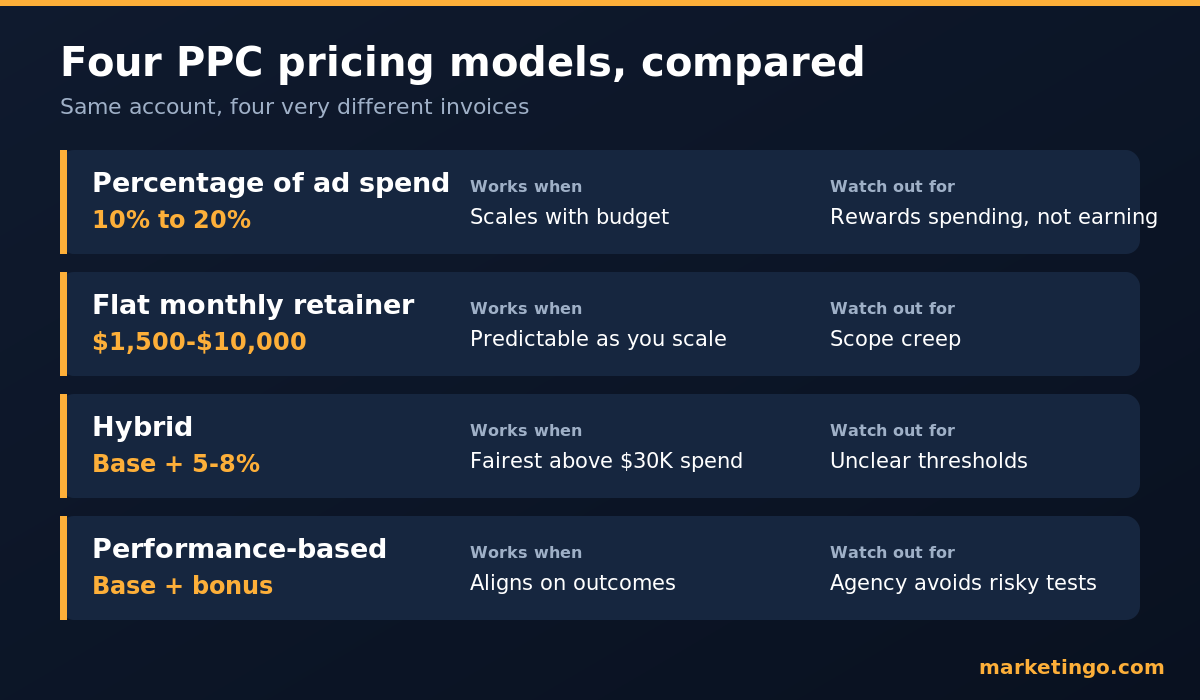
| Percentage of ad spend | 10% to 20%, higher on small budgets | Accounts scaling budget quickly | Rewards spending more, not earning more |
| Flat monthly retainer | $1,500 to $10,000 per month | Stable budgets, predictable scope | Scope creep, or a fee that outgrows the work |
| Hybrid | Base fee plus 5% to 8% above a threshold | Growing accounts above $30,000 spend | Complexity, unclear thresholds |
| Performance-based | Base plus CPA or revenue share | Mature accounts with clean tracking | Gaming the metric, refusing risky tests |
Percentage of ad spend
The oldest of the PPC pricing models, and still the most common. It scales naturally: as your budget grows the fee grows, and the agency's incentive to add channels is at least loosely aligned with your growth. Average PPC fees under this arrangement start near 20% at low budgets and slide toward 10% as spend climbs into six figures.
The flaw is structural. An agency charges more when you spend more, whether or not spending more was the right call. At small budgets the arithmetic also breaks down: 15% of $3,000 is $450 a month, which buys about four hours of a mid-level specialist. Nobody manages a live account properly in four hours.
Flat monthly retainer
A fixed fee, agreed in advance, unchanged by what you spend. Agencies that charge a flat fee tend to attract buyers with predictable budgets, because the cost is knowable and there is no incentive to inflate the media budget. It is also the structure that scales best in your favour: if you triple ad spend, the monthly management fee stays put.
The risk runs the other way. A flat fee tied to a vague scope invites drift, and the same $2,500 that felt generous on one campaign can quietly become thin when the account grows to five. Fix this in the contract with a written scope: platforms covered, campaign count, reporting cadence, and what triggers a repricing conversation.
Hybrid: base fee plus a percentage
A base retainer covers the standing work, then a smaller percentage, commonly 5% to 8%, applies to spend above an agreed threshold. For accounts between $30,000 and $150,000 a month this is usually the fairest structure available: the base pays for the team you need regardless of budget, and the variable slice covers the genuine extra work that scale creates.
Watch two things. The threshold should be written down, and the percentage should be capped so a seasonal spike does not double your invoice for work that did not double.
Performance-based pricing
Payment tied to leads, acquisitions, or revenue, usually on top of a reduced base. It is the arrangement buyers ask for most and get least, for a reason worth understanding: the agency controls maybe half of the outcome. Your offer, your sales follow-up, your prices, and your site do the rest. Pure commission deals also push agencies toward safe, brand-heavy campaigns that hit the target and teach you nothing.
Where it works: a base fee that covers the team, plus a bonus on results above an agreed baseline, with the measurement definition written into the contract before anyone starts. Insist on agreeing what counts as a conversion in advance, because that single definition decides who wins the argument later.
Hourly and project rates
Less common as an ongoing arrangement, but useful in two situations: a one-off account audit, and a build with a defined end point such as a new Shopping feed or a tracking rebuild. At $100 to $149 an hour, a focused 10 hour audit is a cheap way to test an agency before committing to a retainer.
PPC management pricing by budget band
Fee ranges only mean something next to the work they are supposed to fund.
Under $5,000 a month in spend. With a PPC budget this small you are in freelancer or lightweight retainer territory, $500 to $1,500. One platform, usually Google Search. Be honest about what this buys: a few hours a month of maintenance. Many agencies decline accounts this size, and the ones that accept eagerly are often running them on automation with minimal human review.
$5,000 to $20,000 a month. The band where PPC management services start to earn their keep. Fees of $1,500 to $4,000 should cover active search management, negative keyword work, ad testing, and either a second channel or serious conversion tracking. This is also where the percentage and the flat retainer produce similar numbers, so choose the one with the clearer scope.
$20,000 to $50,000 a month. Expect $3,000 to $7,500 and a named senior strategist. At this level a single PPC campaign structure decision is worth more than the entire fee, so paying for seniority is the cheapest thing on the invoice.
Above $50,000 a month. Fees of $7,500 to $15,000, usually hybrid, with enterprise programmes across several platforms running $15,000 to $30,000 and up. The work shifts from campaign management to measurement: incrementality, attribution, and profit modelling.
What a management fee should buy you
Ask any agency to map its PPC services to this list. The answers separate PPC experts from account babysitters faster than a case study deck.
- Named people and stated hours. Who works on the account, at what seniority, for roughly how long each month.
- Structure work, not just monitoring. Campaign and ad group restructuring, search term mining, negative keyword lists, and bid management reviews, on a stated cadence.
- Creative and copy testing. New ad variants and, for paid social, a creative production cadence. On Meta the creative is the targeting, so an agency that never ships new assets is not managing the ad campaign.
- Conversion tracking that survives contact with reality. Server-side or enhanced conversions, offline conversion imports for lead gen, and a documented definition of what counts.
- Landing page input. Even where the agency does not build pages, it should be specifying and testing them, because a landing page decides whether your traffic ever becomes a customer.
- Reporting against profit. Revenue, pipeline, or qualified leads. Impressions and clicks are diagnostics, not results.
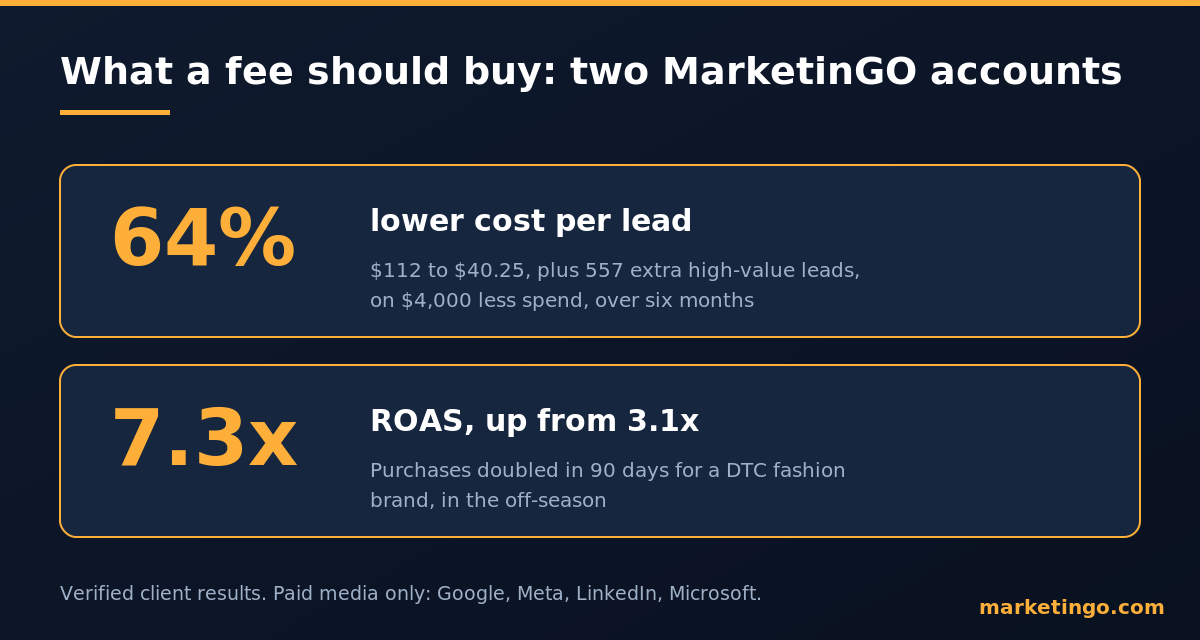
A broader PPC strategy that names the channels you will not run is worth more than one promising all of them, and different PPC platforms deserve different answers here. MarketinGO structures engagements around that discipline, and its published case studies are stated in profit terms: a regulatory-compliance client whose cost per lead fell 64%, from $112 to $40.25, adding 557 high-value leads on $4,000 less spend across six months, and a fashion ecommerce brand whose ROAS moved from 3.1 to 7.3 with purchases doubling in 90 days, in the off-season. Senior operators sit on the account from day one, which is what the fee is actually for.
Why cheap PPC management ends up costing more
Run the numbers on a bargain quote. A $600 monthly fee at a blended $110 an hour funds five and a half hours. In those hours someone has to review search terms, adjust bids, write and test ads, check the tracking, and produce a report. Managing PPC campaigns properly takes longer than that, so what you actually buy is the report.
Now scale the consequence. On a $20,000 monthly budget, the difference between a well-run account and a neglected one is routinely 20% to 40% of spend going to queries that will never convert. That is $4,000 to $8,000 a month of waste, against the $2,000 you saved on the fee. Cheap PPC management is only cheap when measured against the invoice rather than against the media budget it controls.
The same logic sets a floor on when hiring a PPC agency makes sense. Below roughly $3,000 to $5,000 a month in spend, a full retainer eats too much of the total for the arrangement to pay for itself. Either run Google Ads yourself and buy a paid audit once a quarter, or wait until the budget can carry proper management of your PPC ad campaigns.
Agency, freelancer, or in-house: the real cost comparison
Before you hire a PPC agency, price the alternatives honestly. The in-house option is usually costed wrong, because people compare a retainer against a salary and forget everything attached to the salary.
| Option | Real annual cost | What you get | Where it breaks |
|---|---|---|---|
| Freelancer | $9,000 to $30,000 | One specialist, flexible, cheap | Single point of failure, limited channel range |
| Agency retainer | $30,000 to $120,000 | Team, tooling, cross-account pattern recognition | You are one client among several |
| In-house specialist | $95,000 to $130,000 all-in | Full attention, product knowledge | One person's blind spots become your strategy |
| In-house manager plus tools | $140,000 to $180,000 all-in | Senior ownership | Expensive at budgets under $100,000 a month |
Salary data for this year puts a US PPC specialist around $76,286 on Salary.com, with Glassdoor nearer $71,000 and Indeed around $67,000. A PPC manager runs from roughly $110,000 on Glassdoor to $134,510 on Salary.com, and a paid media manager sits near $101,000. Add 25% to 30% for payroll taxes, benefits, software, and recruitment, and a single in-house hire costs more than most mid-market retainers while covering fewer channels.
A marketing agency spreads tooling and senior time across many PPC clients, which is why its effective hourly cost undercuts an in-house equivalent at the same seniority. The honest split: in-house wins when paid media is your primary acquisition engine and spend is high enough to keep a senior person fully occupied. An agency wins when you need several channels covered at once, or when you need senior judgement without a senior headcount. A common third arrangement has the agency doing execution while an in-house marketer owns the strategy and the offer.
How to tell whether you are overpaying
Measuring a fee as a percentage of ad spend tells you almost nothing, because spend is an input. Measure it against the profit the account produces instead.
Take a business spending $30,000 a month with a $4,500 fee. At 3x ROAS the account returns $90,000 in revenue, and at a 45% gross margin that is $40,500 in gross profit. The fee is 11% of gross profit, and the arrangement clearly pays for itself. Hold the fee steady and let ROAS fall to 1.5x, and the same $4,500 now eats 33% of gross profit. Nothing about the fee changed. The fee stopped being fair because the work stopped working.
Three tests worth running this quarter:
- Fee as a share of gross profit generated. Under 15% is healthy for most businesses. Above 30% means either the fee or the performance has to move.
- Trend, not snapshot. Compare cost per acquisition and revenue over the last three months against the three before. A flat account paying a rising fee is a renewal conversation.
- Wasted spend share. Pull a 90 day search terms report from your Google Ads account and total the spend on queries with zero conversions. Anything over 20% is a management problem, not a budget problem.
Our lead generation ROI calculator and ecommerce ROAS calculator do the arithmetic for the first two if you would rather not build the spreadsheet. If the third test is the one that worries you, a free ad account audit will show which queries, campaigns, and settings are absorbing budget, and what a fair fee for that account looks like.
Compare three quotes and you will usually find three different pricing models rather than three different prices, which is exactly why PPC agency pricing models feel impossible to benchmark. Google Ads management pricing is quoted more often than any other channel, so ask each agency to restate its number the same way: as a monthly fee, as a percentage of spend, and as funded hours. Whether you are buying Google Ads management services alone, or paid search management alongside paid social under one full-funnel strategy covering platforms like Google Ads, Meta, LinkedIn, and Microsoft, that translation makes the quotes comparable. If you would rather start from a shortlist, our roundup of the best agencies for ecommerce PPC compares eleven of them by verified results.
Price is the easiest thing to compare and the least useful. Scope, seniority, and the measurement definition decide what you get, and all three are negotiable before you sign and almost immovable afterwards. A PPC management agency that cannot answer plainly on all three is charging you for access rather than for management.